In 2019, Joanna De Vos opened a non-profit project space in Antwerp: SEEN. From a profound belief in beauty, art, and the artist, she invited international artists and guest curators to create a site-specific art installation. Five projects were seen 24/7 through the large welcoming windows of the room. After one year at this fixed location, SEEN spreads its wings in a different, nomadic direction. The art space in Antwerp dissolves, only to recur in various venues all over the world.
Always eager to discover, the mission of SEEN remains to share knowledge and inspiration, with environmental art integrations in unexpected places, and to thereby create surprising art experiences. With SEEN, Joanna De Vos aspires to build an ephemeral ‘scene’: a global platform where curators, artists and audiences can meet in new settings, where unforeseen things can happen and connections can be forged. The advisory board will continue to function as an externalization of this exchanging attitude.
Because SEEN wishes to be an international platform, in which exchange plays a crucial part, an international board of advisors will overlook the quality of the program.
Board of advisors
Edwin Becker, Van Gogh Museum, Amsterdam
Arturo Galansino, Palazzo Strozzi, Florence
Björn Geldhof, Pinchuk Art Centre, Kiev
Stijn Huijts, Bonnefantenmuseum, Maastricht
Dimitri Ozerkov, State Hermitage Museum, St. Petersburg
Juliette Singer, Petit Palais, Paris
Katharina Van Cauteren, The Phoebus Foundation, Antwerp
Marina Vinogradova, NIKA Gallery, Dubai
Oda Jaune, hands
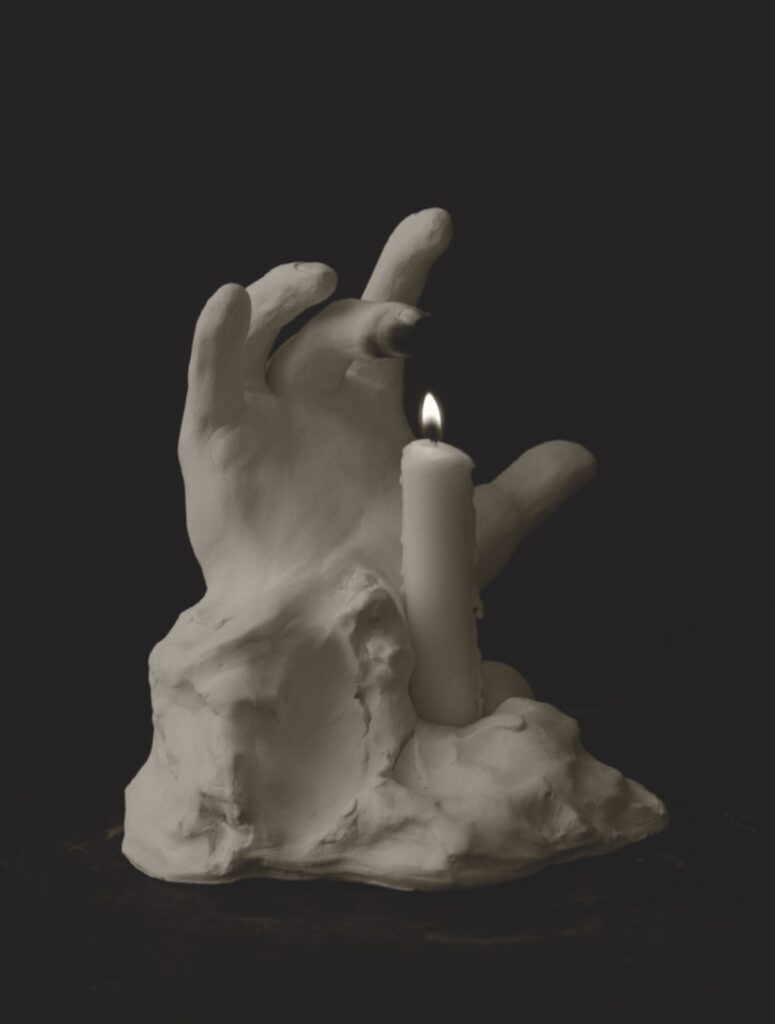
Common sense usually tells us to “not play with fire”. However, the longing to touch the delicate yet powerful flame, dancing on top of a candle, can be great. You will soon realize that the hot flame can burn you, but the attraction does not fade.
Oda Jaune’s installation Hands created especially for SEEN shows a symbiosis of light and shadow, confronting the viewers with the question of their own existence. In absolute silence and as an antidote to our distractive times, the installation explores the theme of perception and represents a never repeating moment. Under the candle flame, the sculpture becomes animated: shadows start to dance, candles melt away. The wax traces left by the melting become a symbol for the inevitable passage of time and the fragility of life – a poignant metaphor for vanity. All the while, the bronze hands burn but seem to resist the pain, as an everlasting material. The installation functions as a memento, created through life and death.
Petrovsky & Ramone, Our Kisses - curated by Laura Adams
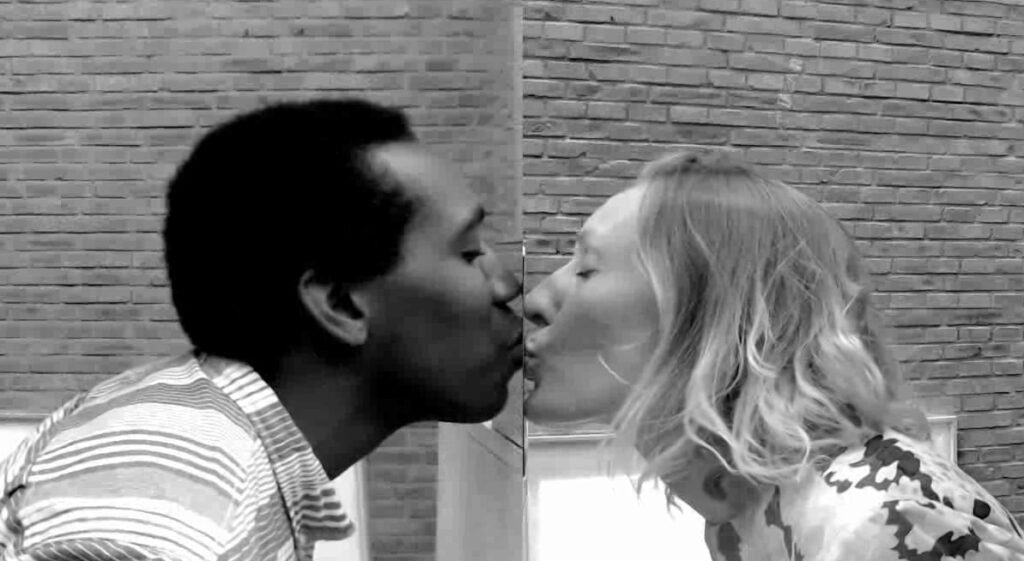
“A desire to unite, instead of divide”
The touch or press of the lips as an expression of affection, love, greeting, or reverence. The ease of sharing a kiss, the significance of receiving it.
Artist duo Petrovsky & Ramone present an installation exploring the themes of love and connection—a desire to unite rather than divide—curated by Laura Adams at SEEN in Antwerp.
Through visual and digital art, they build a world of unconditional love across borders, genders, races, and sexes. The core of the installation serves as a visual reminder that we are all connected, all ONE—not by the self-imposed restrictions of our ‘social’ media, but by a blind love that binds us all.
The Act of Kissing
While a kiss can serve many purposes, its underlying intention is most often rooted in love, affection, and connection. Though deeply personal, the act of kissing is often subject to public judgment. Some societies restrict its expression; others allow it, but not between all people.
We are all human beings searching for acceptance and protection—to be united with the whole, seeking a greater connection. Why can’t it be as simple as a kiss?
Curatorial Statement
The concept of Our Kisses engages with contemporary questions surrounding privacy, the boundaries of love, and the unification of humankind. What could be more fundamental than being united through a kiss?
From Correggio to Klimt, from Munch to Rodin, the theme of the kiss has been widely explored throughout art history. Petrovsky & Ramone present a simple, universal concept that actively engages the viewer, combining elements of surprise, wit, and emotional resonance. The physical act heightens awareness of its meaning, while simultaneously immersing the viewer in the work itself.
Uldus Bakhtiozina, Miss Future

Uldus often plays a character – as a form of escapism but also to bring across a sharper message. The artist holds a degree in politics, and this influences some of her work, as is the case in ‘Miss Future’. The installation is informed by the relation between Russia and China, which has been very difficult in the past. Today, everywhere we look, China seems to be taking over the world. It is the world’s largest manufacturing economy and exporter of goods; all objects and clothes we buy – no matter where – seem to be ‘Made in China’, and it has an extremely elaborate market in copied versions of big brands. All eyes are on China – waiting to see what the future holds.
‘Miss Future’ overlooks the current world, as a kind of broadcaster or spokesperson for a changing and challenging society. She herself is a vision of the future – a manufactured, reconstructed, copied version of a person – at all times she sees and is seen, yet she is apparently also missing. Because of her many different guises, the search for ‘Miss Future’ will prove to be a difficult one.
José Angelino, Sometimes it Leaps Forth - curated by Melania Rossi
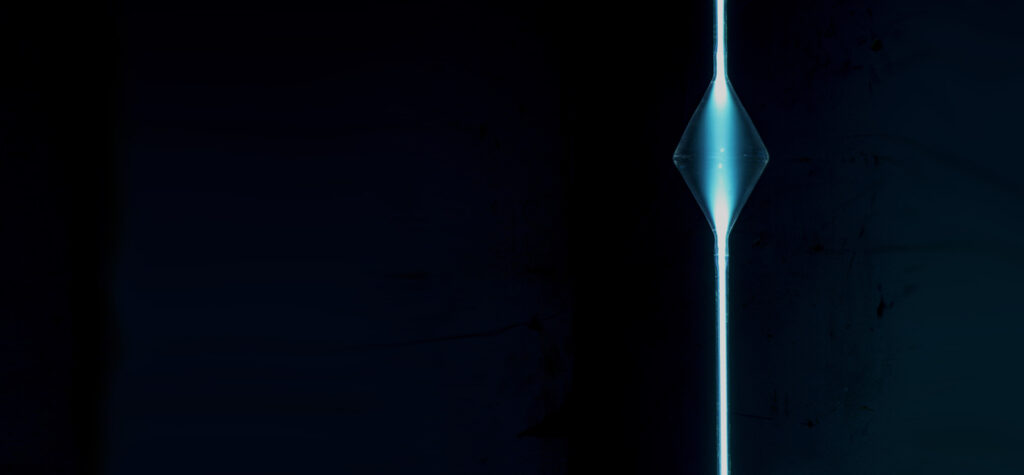
José Angelino draws and creates sculptures applying behaviours and laws of nature.
His artistic research is inspired by the observation of natural events and their dynamics, their occurrence and “preferential” development. His works play with the interference, the resonance and the natural flows of energy, merging scientific experiments and artistic practices. Angelino comes from a physics background, but he has later discovered that it is the poetics of natural dynamics that interests him most; his academic knowledge of classical physics and quantum mechanics, influences the way he creates works of art.
With this attitude the artist creates sculptures that reproduce and modify the development of a natural event: by interposing obstacles he generates interference, he expands the flowing of elements and then he forces it by investigating the thin and indefinite boundary between space and light.
“It is probably true quite generally that in the history of human thinking the most fruitful developments frequently take place at those points where two different lines of thought meet. These lines may have their roots in quite different parts of human nature, in different times or different cultural environments or different religious traditions: hence if they actually meet, that is, if they are at least so much related to each other that a real interaction can take place, then one may hope that new and interesting developments may follow”. (Werner Karl Heisenberg)
Markus Raetz, Kopflose Mühle

So often our vision plays tricks on us: you think you see someone you know from the corner of your eye. You turn and blink, and the person is gone. Was what you saw real or just a play of the light, or even a whim of your imagination? There is no way of knowing for sure.